
Boone County Parole Versus Probation
Parole is conditional release from incarceration. The independent West Virginia Parole Board decides whether an eligible person may leave confinement on parole and adjudicates revocation matters. WVDCR Parole Services then supervises the person in the community. Probation is different. A circuit court imposes probation, sometimes instead of jail and sometimes after a jail component, and judicial probation staff oversee the order. Neither system is a complete list of everyone released in Boone County.
The source of the order is the best first clue. A parole eligibility date means only that the Board may consider release. It is not a promise. A Board grant is conditional and can be followed by intake, fingerprinting, home-plan work, or detainer review before physical release. Probation normally appears in the Boone criminal docket and sentencing order. A person can also complete custody with neither form of supervision.
| Question | Parole | Probation |
|---|---|---|
| Who orders it? | West Virginia Parole Board | Circuit court |
| Who supervises? | WVDCR Parole Services | Judiciary probation staff |
| When does it begin? | After actual release on a Board grant | As the court order directs |
| Best public starting point | DCR record and court docket | Sentencing order and court docket |
| How does it end? | Board discharge or other lawful termination | Court completion or discharge |
- Eligibility
- The date when parole consideration may begin. It creates no right to release.
- Grant
- A conditional Board decision approving parole, subject to required processing.
- Discharge
- The formal end of custody or supervision, not merely a move out of a facility.
- Absconder
- A person alleged to have stopped complying with supervision and whose status may require official action.
Check Boone County Supervision Status
No official public name-based directory of ordinary Boone parolees was found. Verification therefore requires a short chain of sources. The chain should establish the controlling order, the physical release event, and the present status. A current jail-search miss does not establish any of those facts. It can also reflect transfer, delay, a spelling issue, or another custodian.
- Identify whether the person left Southwestern Regional Jail, a state prison, or only changed status under a court order.
- Search the Boone magistrate and circuit case routes from the West Virginia Court Record Access page. Read the sentence and later orders.
- Use the official WVDCR search hub for the matching jail or prison custody class. Treat no result as a lead, not proof.
- For known parole, contact the Logan Parole Office and ask what status information may lawfully be confirmed.
- For probation, use the Boone/Lincoln Ninth Judicial Circuit contact shown by the state courts. Call before travel.
- Ask for a DCR release or discharge record when the online and court sources do not resolve the status.
A parole file and a court file answer different parts of the question. The court shows the conviction, sentence, and later judicial action. DCR can hold commitment, release, method of discharge, parole eligibility, probation action, and actual-release information under Policy Directive 142.00. The public web search was not verified to display all of those fields, so a focused records request may be needed.
For the full custody and court sequence, the Boone County released-inmate search explains how regional-jail, DCR, and court records fit together.
Boone County Parole Hearing Records
The Board's official hearing information says hearings occur monthly at each institution. Regional-jail hearings are conducted monthly by video teleconference. A PED, or parole eligibility date, is not a guaranteed interview date and never means the person has been released. The general baseline in West Virginia Code §62-12-13 is the minimum of an indeterminate sentence or one-fourth of a definite term, but the statute contains exceptions tied to the offense, sentence, and program rules.
No current official public calendar naming individual hearing dates was located. No official public decisions or results database was verified either. Do not substitute a news report or an unofficial list for a Board record. A case-specific schedule inquiry can be directed to the West Virginia Parole Board, 1409 Greenbrier Street, Second Floor, Charleston, WV 25311, at 304-558-6366, subject to lawful disclosure limits.
The Board describes denial, set-up, and grant as distinct results. Denial keeps the person confined and establishes a later review period. A set-up schedules another hearing, generally within the Board's stated one-to-eleven-month range. A grant approves parole conditionally. Plans, intake, detainers, and other processing can still delay or prevent community release.
The official monthly-hearing page shows the cadence and PED distinction.
The captured state page supports a monthly process, not a public Boone County decision-search tool or an exact physical release day.
Note: Section 62-12-13a states that parole eligibility does not create a right to parole or release.
Boone County Parole Grant Timing
A regional-jail parole grant has a Boone-specific practical wrinkle. Southwestern Regional Jail and Correctional Facility is the adult facility serving Boone, but a grantee there does not walk out at the hearing. The Board FAQ says the person must transfer to a DCR facility for intake and fingerprinting. It tells readers to anticipate roughly seven to ten days before actual release.
That interval shows why four dates must stay separate. Eligibility is when review can begin. The decision date is when the Board acts. Physical release is when confinement ends. Supervision begins only when the person leaves on parole and reports as directed. A detainer or unresolved plan may instead lead to continued custody or a transfer to another authority.
A VINE status change may help track movement, but transfer alerts can follow arrival at the new facility rather than the moment of movement. Confirm the event with DCR. The record should say whether the person entered the community, changed facilities, or remained held for another custodian.
Boone County Parole Conditions
WVDCR publishes standard parole conditions. Purpose-neutral examples include reporting to the parole officer within 24 hours of release, reporting thereafter as directed, promptly reporting an arrest, and filing monthly written reports. The individual certificate and officer instructions control. A condition should not be inferred merely because it is common.
The WVDCR standard-conditions page provides the official statewide context.
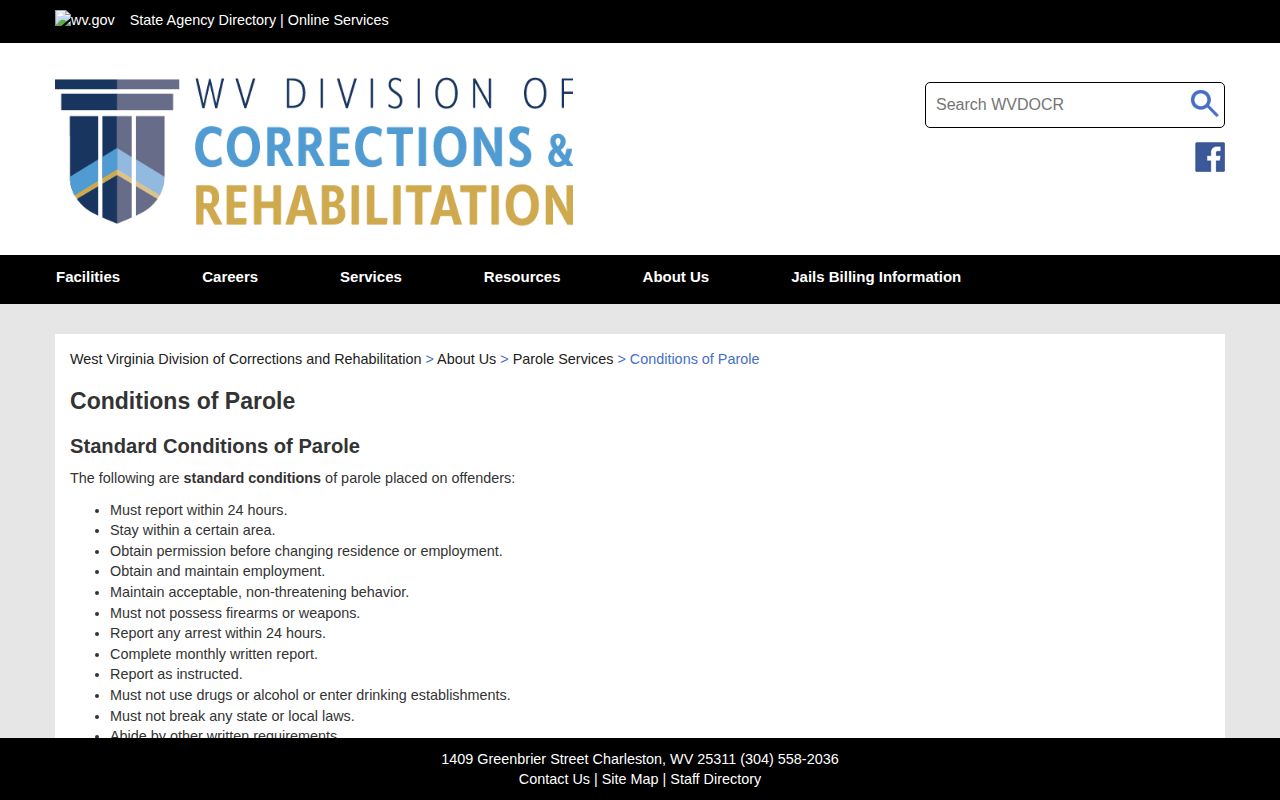
The state page helps explain active supervision, but it does not identify whether a named Boone County person is presently on parole.
A reported violation does not by itself prove revocation. Parole revocation follows its own report and adjudication process. Probation violations return to the court under the probation order. In either system, use the current official record and avoid treating an allegation as a final disposition.
Boone County Absconder Record Check
DCR's search hub provides a separate Escapees and Absconders route. That special route is not the jail search, prison search, or a directory of all people on parole. A confirmed hit signals an active custody or supervision concern and should be read exactly as the agency labels it. It is not ordinary release status.
No hit has a much narrower meaning. It does not prove that supervision ended, that the person complied with all terms, or that a warrant does not exist in another system. Verify known parole through Parole Services and known probation through the Boone court. If a warrant question matters to an active legal case, use the issuing court or agency.
Does an absconder result mean parole was discharged? No. An absconder entry points toward alleged noncompliance. A discharge is a separate formal act ending supervision.
Boone County Reentry Supervision Programs
The state's Boone County profile identifies Southwestern Regional Day Report Center as a community asset. The West Virginia Judiciary also lists Boone/Lincoln Adult Treatment Court. These programs help explain why structured reporting, treatment, testing, or court review may follow release from jail. They are not inmate locators and do not supply a public list of participants.
The distinction matters when a court docket refers to a program. Day reporting can be part of a community corrections plan. Treatment court is a judicial program with its own order and review process. Neither phrase proves parole, and neither should be used to infer a named person's release status without the controlling court or DCR record.
Use the Boone/Lincoln Adult Treatment Court page only for official program context. For an individual case, the sentencing order and later docket entries remain the source.
Note: Program participation and post-release supervision overlap in some cases, but they are not interchangeable legal statuses.
Boone County Supervision Office Contacts
Boone parole is served from DCR's Logan office, not an in-county parole office. Court probation belongs to the Ninth Judicial Circuit. The state court page lists a Boone probation telephone while displaying a Lincoln courthouse address, so calling before travel is especially important. Neither office should be treated as a general public custody-history search.
Logan Parole Office
WVDCR Parole Services, Southern District Region 2
1103 George Kostas Drive, Suite 200
Logan, WV 25601
304-792-7218
Serves Boone, Logan, and Mingo Counties. Call first.
Boone Judicial Probation
Ninth Judicial Circuit
304-369-7373
Confirm the correct office location and permitted inquiry before visiting.
The Logan office may confirm only what law and policy allow. For probation, begin with the public Boone case and its sentencing order. Office staff are not a substitute for the release record, and a supervision contact does not establish the date confinement ended.
Boone County Supervision Discharge
Leaving custody on parole is not the same as completing parole. The Board FAQ says one year of successful parole does not itself prove discharge. The supervising officer supplies a progress or status report, and the Board acts on discharge eligibility. Until a formal action ends supervision, the person may remain subject to the parole certificate even though no longer confined.
Probation also ends through the terms and authority of the court order. The docket may contain completion, revocation, extension, or discharge action. Read the actual entry. A final supervision discharge should not be inferred from a silent current jail roster, the end of a listed jail term, or the absence of an absconder hit.
The clean record sequence is custody release, supervision start, any later status action, then final discharge. If DCR or the court will not confirm a detail by phone, request the existing public portion of the record. That approach keeps Board decisions, physical release, community supervision, and sentence completion in their proper order.