
Boone County Projected Release Dates
West Virginia's precise administrative term is “projected minimum discharge date.” WVDCR Policy Directive 142.00 lists that field as a public-information category in an offender record. It represents a sentence calculation based on the record available at that time. It should not be announced as an exact exit appointment.
An actual release is a completed custody event. It can occur through sentence discharge, parole, bond, court order, or another lawful route. A transfer ends one facility stay but continues custody. Mandatory post-release supervision may begin when confinement ends, which means physical release is still not unconditional sentence discharge.
| Date or event | Meaning |
|---|---|
| Parole eligibility date | First point when Board consideration may be allowed; no right to release |
| Projected minimum discharge | DCR sentence-administration estimate affected by credit and other changes |
| Board decision date | Date of grant, denial, or set-up; not physical release |
| Actual physical release | Date confinement ends or custody transfers, as the record specifies |
| Supervision discharge | Later formal end of parole, probation, or mandatory supervision |
These dates can fall far apart. A regional-jail parole grant, for example, still requires DCR intake and fingerprinting. A detainer can move the person into another agency's custody. Always record the event name with the date.
Boone County Release Date Paths
The correct source depends on why the person is confined. A Boone arrest normally leads to Southwestern Regional Jail and Correctional Facility, which is a WVDCR regional jail in Holden. A longer state sentence can place the person at any DCR prison. The Boone court remains essential because its bond, sentence, presentence credit, and later orders form the legal base for the correctional calculation.
Pretrial detention has no computed sentence-ending date. The next event may depend on bond, dismissal, plea, trial, or another court order. A county or regional-jail sentence can have a defined term, but DCR and the court must reconcile credit and legal holds. A state prisoner's sentence statement is managed by DCR.
- Pretrial detainee
- A person held while the case is pending. No final sentence exists yet.
- Determinate sentence
- A fixed term used as the base for lawful credit calculations.
- Indeterminate sentence
- A sentence stated as a minimum and maximum, with different parole and discharge roles.
- Detainer
- A request or legal hold that can lead to continued custody or transfer when the current stay ends.
The federal system uses different law and a different locator. Do not apply West Virginia day-for-day rules to a BOP sentence. Donald R. Kuhn Juvenile Center is also outside this adult workflow because youth release information is restricted.
Find Boone County Projected Discharge
The official DCR landing page separates jail search, prison search, Daily Incarcerations, and Escapees/Absconders. Choose the custody class that matches the person's history. The live prison application could not be opened during research, so no current online projected-date field was verified. The safe route uses the public locator for current identity or custody, then requests the existing DCR fields.
- Identify whether the person is pretrial, serving a regional-jail term, or serving a state-prison sentence.
- Open the WVDCR offender-search landing page and select jail or prison search as appropriate.
- Match the exact name and any official identifier. Note the date of the search.
- Check the Boone magistrate or circuit case for bond, sentencing, presentence credit, and later orders.
- If no verified date appears online, request the projected minimum discharge date and current sentence statement from DCR.
- Ask Southwestern at 304-239-3032 whether a regional-jail event was release, transfer, or another hold.
- When the date arrives, confirm actual release through DCR, the court, or a VINE notice followed by agency verification.
A focused request can ask for commitment and release dates, projected minimum discharge, good-time allowance and rate, method of discharge, completed transfer destination, sentence-change reason, and the linked docket number. Policy 142.00 recognizes these as DCR-held categories, subject to lawful withholding or redaction. That does not mean every category is visible in a web result.
The Boone County release-record workflow adds the full court and facility fallback when a current search produces no match.
Note: A missing jail or prison result is not release proof; it may reflect transfer, delay, spelling, or another authority.
Compute Boone County Minimum Discharge
West Virginia Code §15A-4-17 supplies the adult DCR good-time framework. For an eligible person serving a court-ordered misdemeanor or felony term, one day of good time accrues for each day physically incarcerated. Qualifying presentence jail credit can count. The credit is deducted from the maximum term of an indeterminate sentence or from the fixed term of a determinate sentence.
The conceptual sequence is clear, but it is not a safe do-it-yourself release promise:
- Start with the court's controlling maximum or fixed term.
- Aggregate consecutive maximum terms when the statute requires it.
- Apply verified presentence custody credit.
- Accrue only eligible good time for days physically incarcerated.
- Subtract forfeited credit and add restored credit.
- Add any authorized extra or program credit.
- Account for mandatory post-release supervision treatment.
DCR performs the operational calculation. It has the sentence structure, custody history, discipline record, program record, and statutory rules for the individual. A public estimate can miss a consecutive sentence, a corrected order, or credit that has not yet posted.
The official good-time and minimum-discharge statute provides the controlling statewide text.
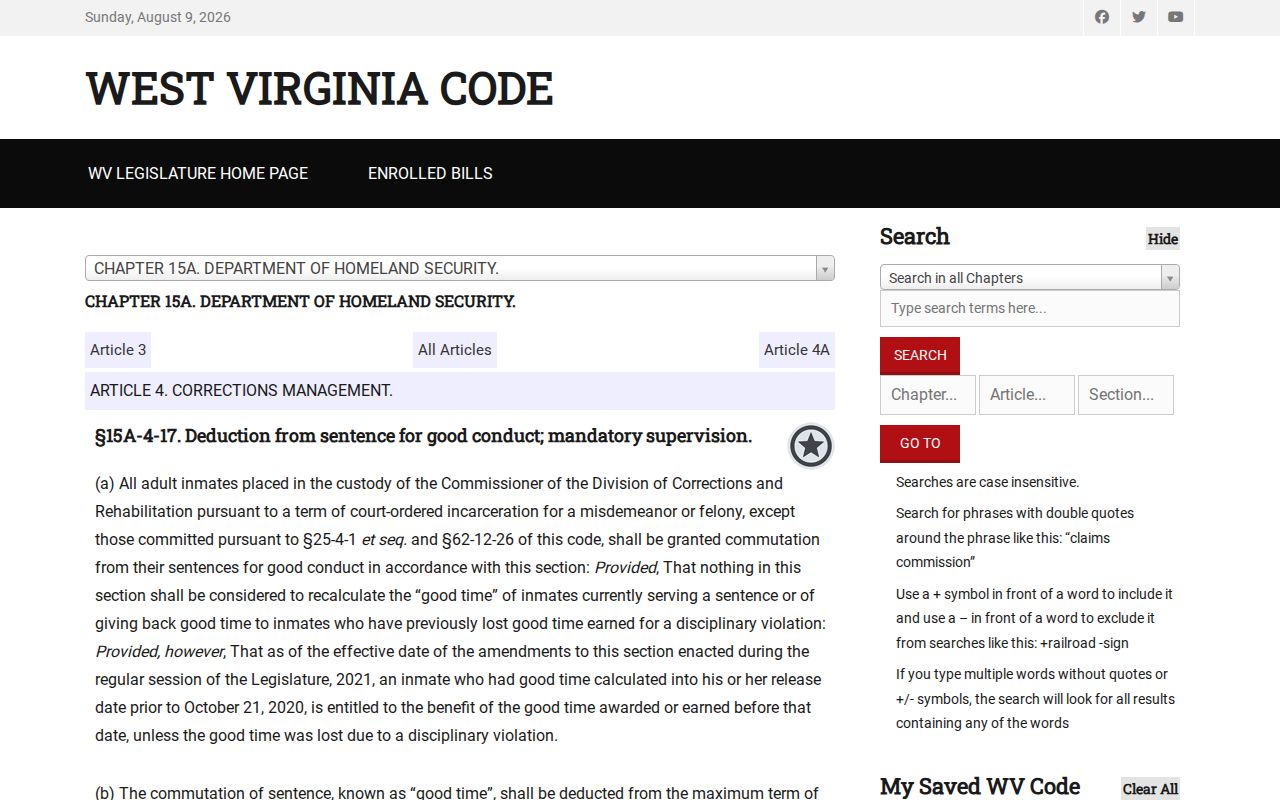
The statute image supports the legal framework, while only DCR's current sentence statement can apply it to a named offender.
Boone County Good-Time Eligibility
Good time accrues during eligible physical incarceration. It does not accrue while the person is on parole, bond, or another nonincarcerated status. A life sentence earns no good time under this rule. Presentence days count only when they qualify as jail credit against the controlling term.
Disciplinary violations can cause forfeiture. The commissioner may restore credit, and DCR must revise the sentence or minimum-discharge statement when forfeiture or restoration changes the earliest date. The commissioner may also award extra good time for meritorious or emergency service.
Eligible felony inmates may receive up to 90 days for approved optional academic or vocational programming that was not required by the individualized reentry plan. That maximum is not an automatic award. Program approval and the person's record control.
Does West Virginia require every state prisoner to serve 85 percent? No general state rule of that kind was located. Boone and WVDCR content should use the statutory day-for-day framework and its exceptions, not import the federal good-conduct concept.
Boone County Sentence Structure Changes
Sentence structure is one of the most important calculation quirks. A determinate term uses a fixed base. An indeterminate term uses a minimum and maximum for different legal purposes. Consecutive terms run one after another and can change the aggregate maximum used for good time. Concurrent terms run together as the court directs.
A later court order can correct jail credit, change how counts relate, vacate a conviction, or otherwise alter the sentence DCR administers. DCR should receive the controlling order and revise its statement. Until that reconciliation occurs, a date based on an older docket entry may be stale.
Parole eligibility is calculated under a different statute and should not be substituted for minimum discharge. Section 62-12-13 generally allows consideration after the minimum of an indeterminate sentence or one-fourth of a definite term, with many exceptions. Section 62-12-13a expressly rejects any right to parole merely because eligibility has arrived.
Note: Use the offense date and applicable statute version when special parole rules or life-sentence thresholds may apply.
Boone County Mandatory Supervision Dates
For listed violent or person offenses, minor-victim offenses, and firearm felonies committed on or after July 1, 2013, §15A-4-17 deducts one year from accumulated good time to create one year of mandatory post-release supervision. That period includes electronic or GPS monitoring. Courts may order up to 180 days for certain other felonies.
This rule changes how the date should be described. The person may move from a facility into supervised community custody before unconditional sentence discharge. Physical release has occurred, but the sentence has not ended in the ordinary sense. The record should identify both the custody exit and the supervision period.
Conditional release under §15A-4-17a also should not be equated with unconditional discharge. The official conditional-release statute provides that distinct framework.
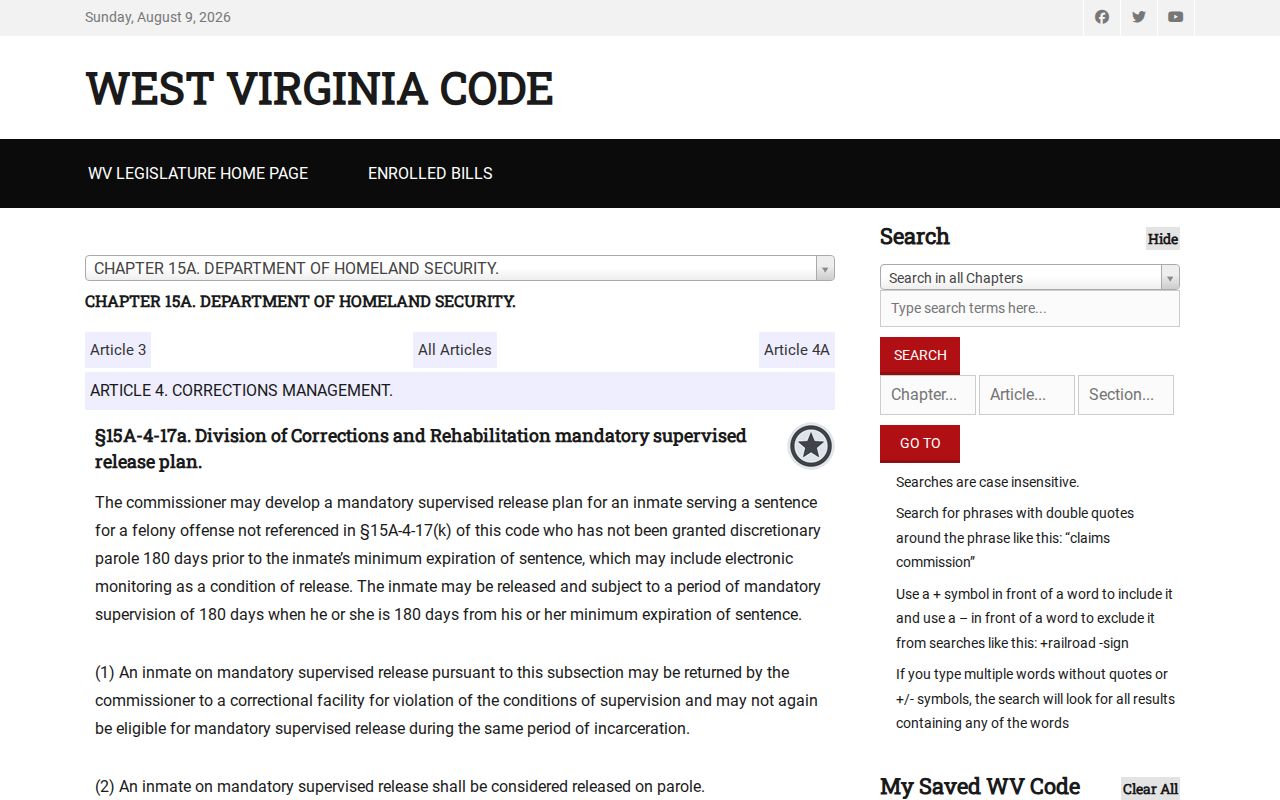
The statute confirms a separate legal release route. It does not announce that a specific Boone County person qualified or left custody.
Why Boone County Release Dates Change
A projected date changes when the facts or legal inputs change. Some changes move the date earlier, while others move it later or turn expected community release into a transfer. The current DCR sentence statement is stronger than a saved screen or an informal calculation.
| Factor | Possible effect | Best confirmation |
|---|---|---|
| Disciplinary forfeiture | Removes earned good time and can move the date later | Revised DCR sentence statement |
| Restored or extra credit | May move the minimum discharge earlier | DCR credit record |
| Program credit | May add authorized credit within statutory limits | DCR program and sentence record |
| Presentence credit correction | Changes credited custody days | Court order and DCR statement |
| Consecutive sentence | Changes the controlling aggregate term | Sentencing orders |
| Parole grant or denial | May create a release process or leave custody in place | Board record plus actual DCR release |
| Detainer or hold | Can lead to another custodian instead of community release | DCR and receiving agency |
| Mandatory supervision | Changes confinement exit into supervised release | DCR release and supervision records |
A transfer can make the old facility result disappear. That is not an early release. Likewise, a Board grant can be followed by plan approval, intake, fingerprinting, or detainer processing. The actual event must be checked after it happens.
Boone County Parole Date Differences
Parole adds another set of dates. The eligibility date opens the door to possible review. Monthly regional-jail hearings may occur by video teleconference, but a PED does not guarantee an interview. A denial keeps the person confined. A set-up schedules later Board review. A grant authorizes a conditional process.
For someone granted parole while at a regional jail, the Board FAQ warns that DCR intake and fingerprinting require a transfer and roughly seven to ten days before actual release. A home plan or detainer can add another issue. Thus the Board decision date should never be copied into a release-date field unless the release record confirms they match.
Parole supervision then continues until formal discharge. One year of successful parole does not automatically end it. The supervising officer reports status, and the Board acts on discharge eligibility. Keep prison release and parole discharge as separate milestones.
Confirm Boone County Actual Release
As the projected date approaches, check the DCR custody record and the latest court orders. A Boone County VINELink release check can provide notice of a status change. VINE can lag, and its transfer notice follows arrival at the new facility rather than the instant of movement, so the alert still needs agency confirmation.
For a Southwestern record, call 304-239-3032 and ask whether the event was community release, transfer, or another detainer pickup. For documentary proof, request the existing commitment and release entry, method of discharge, completed transfer destination, and actual release field where applicable. If the sentence or bond is disputed, use the Boone magistrate or circuit clerk record.
Do not publish a future date as settled fact. Label it “projected minimum discharge” and include the source date. Once custody changes, replace the projection only with an official actual-release, transfer, or discharge event. That preserves the difference between a calculation and what occurred.